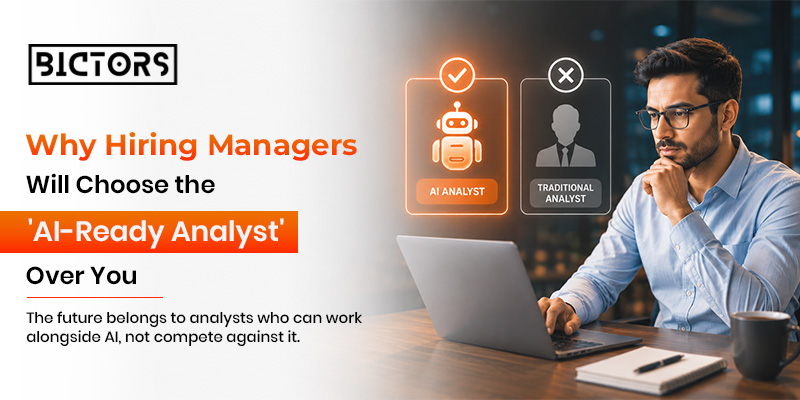
Most people applying for data analyst roles right now have decent skills. SQL, Excel, maybe some Power BI. The problem is, so does everyone else in the applicant pool. Hiring managers are now looking for people who can do the job faster and with less manual effort by using AI tools. An AI and automation course in Bhubaneswar has quietly moved from a career upgrade option to something that decides whether your resume even gets a second look.
Table of Contents
- Who Is an AI-Ready Analyst and What Makes Them Different?
- How Have Data Analyst Job Descriptions Changed in the Last Three Years?
- What Skills Do Hiring Managers Look for in AI Data Analysts Now?
- What Is the Difference Between a Regular Data Analyst and an AI Data Analyst Salary?
- Will AI Replace Data Analysts or Just Change What They Do?
Who Is an AI-Ready Analyst and What Makes Them Different?
An AI-ready analyst does the same job as a regular analyst, just with a lot less manual work slowing them down. Instead of spending hours cleaning data and fixing spreadsheets, they set up systems that handle that automatically. The time saved goes toward figuring out what the data actually means and what the business should do about it. The skills are similar, but the approach has changed.
How Have Data Analyst Job Descriptions Changed in the Last Three Years?
A data analyst job posting from three years ago looks very different from one today. Then SQL and Excel were enough. Today, the same job postings are asking for prompt engineering, AI-integrated workflows, and natural language querying.
What Modern Job Descriptions Now Ask For:
- AI-Assisted Tools: Knowing your way around BI platforms that use AI to update dashboards on their own, without someone rebuilding them every week.
- Language Model Experience: Getting AI to write and fix code for you, so you are not stuck debugging syntax for hours.
- Automated Pipelines: Understanding how data flows from place to place without a human having to move it by hand every time.
- Data Governance: Sensitive data does not cease to be sensitive simply because an AI is handling it. Companies want analysts who already know that.
- Business Translation: Taking what the AI finds and explaining it in a way that someone who has never opened a spreadsheet can still act on.
Curious about what an AI data analyst’s workday looks like? This one is worth a read: A Day in the Life of an AI Data Analyst: What’s It Like
What Skills Do Hiring Managers Look for in AI Data Analysts Now?
Skills that separate shortlisted AI data analyst candidates from rejected ones are:
- Prompt Engineering: Telling an AI tool exactly what you need, whether that is a query, a cleaned dataset, or a chart, without having to build it line by line yourself.
- AI Tools for Data Analysts: Actually having used platforms that automate reporting and flag patterns, not just having heard of them.
- Python Basics: Not enough to build something from scratch, but enough to look at what the AI generated and catch when something is off.
- ML Workflow Understanding: Knowing roughly how a predictive model reaches a conclusion and what kinds of mistakes it tends to make.
- Data Storytelling With AI Outputs: Taking what the system spits out and turning it into something a non-technical manager can read and act on without asking follow-up questions.
What Is the Difference Between a Regular Data Analyst and an AI Data Analyst Salary?
The pay gap between a regular analyst and an AI-ready one is something most people do not expect until they see it. Companies are willing to pay more for someone who reduces manual work, speeds up reporting, and brings real strategic thinking to the table. Two analysts with the same job title can be earning very differently based on this alone. At senior levels, that gap gets even harder to ignore.
Will AI Replace Data Analysts or Just Change What They Do?
AI is not replacing data analysts, but it is not leaving the role untouched either. What it is doing is taking over the repetitive tasks, like recurring reports, data cleaning, and manual number-crunching that eat up most of a regular analyst’s week.
Once that is automated, what remains is the work that actually matters: reading between the lines, understanding the business context, and turning data into a decision someone can act on. Those who understand this are already figuring out how to become an AI-ready analyst before the rest of the market catches up.
Wrapping Up
The analyst hired in 2026 is not the most experienced. They are the ones whose skills have kept up. Joining Bictors’ AI and automation course in Odisha is the most direct way to close that gap. Get in touch for more information.
Wondering whether AI-generated insights can actually be trusted in real business decisions? That is worth reading about before your next career move.
Frequently Asked Questions
- Is an AI and automation course in Odisha worth it for someone already working as a data analyst?
Yes, especially if the curriculum covers real tools and workflows rather than just theory.
- How long does it take to go from a traditional analyst to an AI-ready one?
Most working analysts make the transition within six to nine months with the right structured programme.
- Do AI-ready analysts need to know how to code from scratch?
No, but understanding enough code to read and validate AI-generated scripts is expected in most roles today.