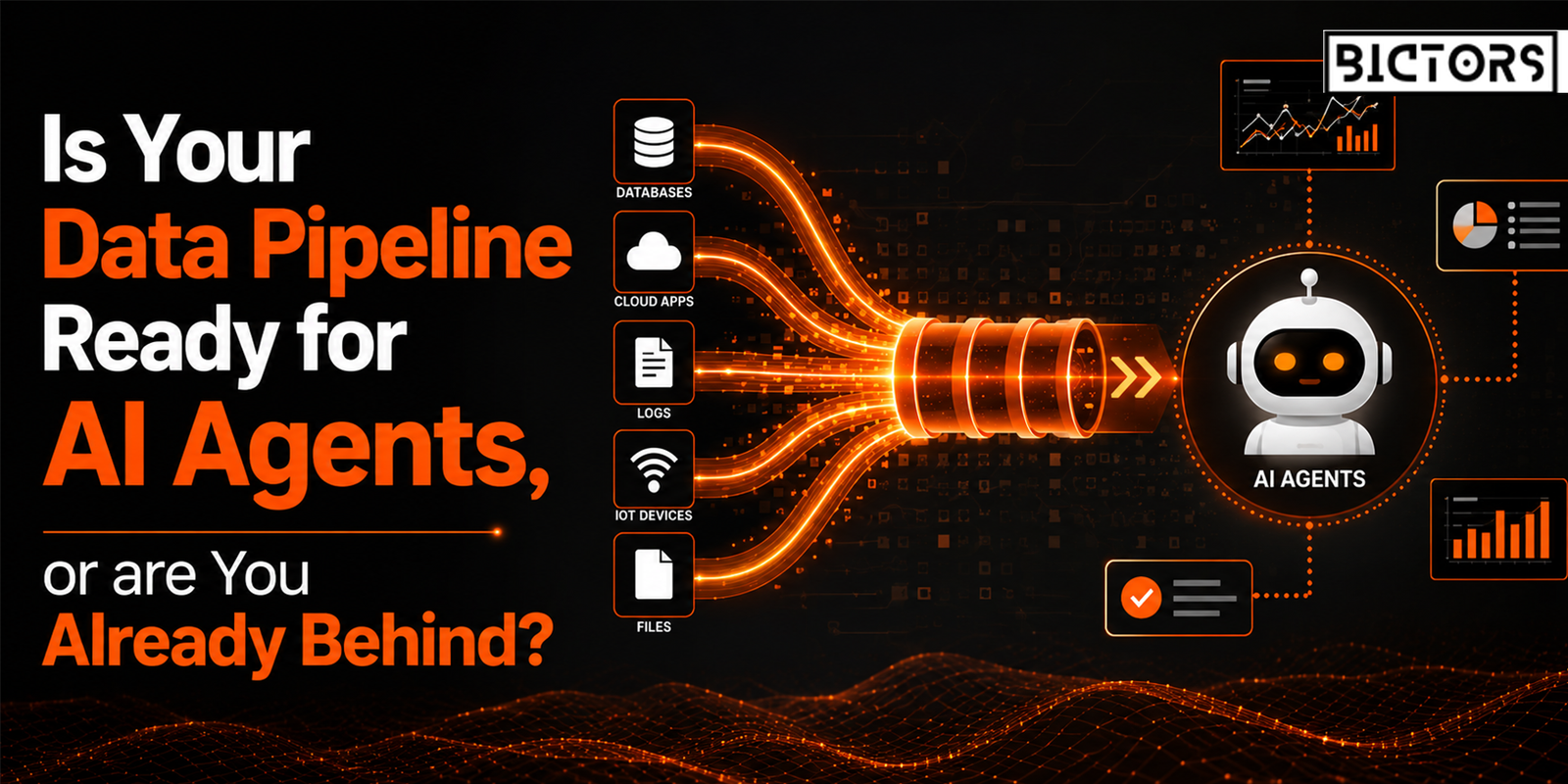
If your pipeline still runs on old-school logic, you’re already behind. Companies pour money into flashy agents, then wonder why the outputs are wrong, inconsistent, or plain confusing. An AI agent is only as smart as the pipeline behind it, and no amount of AI polish can fix what’s broken underneath. A good data engineering course can teach the mindset shift needed to build for agents instead of just dashboards.
Table of Contents
- What Is an AI-Ready Data Pipeline and How Is It Different From a Traditional One?
- How AI Agents Break When Data Pipelines Are Not Built for Them?
- Why Do Agentic AI Systems Demand a Different Kind of Data Infrastructure?
- What Is the Shift From Batch Processing to Real-Time Data Flows in 2026?
- What Are the Skills You Build in an AI Data Engineering Course That Close This Gap?
What Is an AI-Ready Data Pipeline and How Is It Different From a Traditional One?
An AI-ready pipeline is built to feed data continuously and with context, while a traditional pipeline just moves data from one place to another on a fixed schedule. That’s the core difference: one keeps agents constantly updated, the other is designed for humans checking in periodically.
For a human checking a report once a day or once a week, a delay of a few hours barely matters. Agents don’t work that way. They need current, correctly labelled data the moment they act, or they end up making decisions on information that’s already outdated.
How AI Agents Break When Data Pipelines Are Not Built for Them?
Agents break when they act on stale, messy, or unstructured data without realising anything’s wrong. Unlike a human, they don’t stop to double-check before moving forward. They continue to execute on outdated numbers, sounding just as confident as they would if the data were correct.
That’s what makes broken pipelines so dangerous. Nothing stops the agent from acting on bad data, so small errors turn into bigger ones before anyone catches them.
Why Do Agentic AI Systems Demand a Different Kind of Data Infrastructure?
Agentic systems need infrastructure that can follow a chain of steps, weigh context, and make a call, not just hold data until someone pulls it up. That means building in semantic context, setting clear permission boundaries, and constantly validating, not once a quarter.
Old infrastructure was built with a simple task: to let a person read a report. Agent infrastructure has a harder job. It has to let a machine act. Running an AI agent data readiness assessment before deployment catches these problems while they’re still small and easy to fix, instead of finding out the hard way when an agent makes a call nobody can trace back or explain.
What Is the Shift From Batch Processing to Real-Time Data Flows in 2026?
Agents now get what they need, when they need it. Data updates continuously, not on a schedule. This is a real-time data streaming architecture at work.
Batch processing worked fine when humans only checked reports once a day. Agents run on seconds, not days, so every update needs to move as it matters right now. A modern data pipeline design for AI workloads treats every update like breaking news, not a weekly summary.
Why teams are switching today:
- Faster Decision Cycles: You catch an opportunity while it’s happening, not two days later when the report finally lands.
- Real-Time Accuracy: The agent’s working off today’s numbers, not last week’s.
- Quicker Error Detection: Something breaks, someone knows fast, not a week from now.
- Better Scalability: More data comes in, the system keeps up, nothing slows down or falls over.
Curious how cloud choice fits into this shift? Read this blog: Why Are Data Engineers Choosing GCP Over Other Cloud Platforms?
What Are the Skills You Build in an AI Data Engineering Course That Close This Gap?
A good data engineering course teaches you to actually build streaming systems, set up validation, lock down security, and design agent-ready architecture, not just talk about it in slides. These are the data engineering skills for the AI era that most teams are currently missing, and they’re the ones that matter most as more companies adopt agentic AI.
Skills that make the real difference:
- Streaming Pipeline Management: You build and run the systems that keep real-time data moving.
- Schema Validation: You set up checks that flag bad data before it causes problems.
- Access Control: You get to say exactly what the agents can and can’t touch.
- Feedback Loop Design: Creating systems that learn from each run instead of staying static.
- Vector Databases and Context Layers: You learn what actually powers agent-ready data under the hood.
Ready to Build Pipelines That Keep Up With Agentic AI?
AI agents aren’t slowing down; they’re only becoming more common. Whether your pipeline is ready or already falling behind comes down to the choices you make today. At Bictors, you’ll learn data engineering and build pipelines that can actually keep up with agentic AI, before catching up gets too expensive. Contact us to join the course today.
Curious what happens when AI starts writing its own queries, too? That’s a conversation worth having next.
Frequently Asked Questions
- How long does it take to build a production-ready data pipeline?
The timelines vary, but with focused effort, most companies see solid progress within a few months.
- Do small businesses need agent-ready pipelines too?
Increasingly, yes, small teams rely on automation for daily decisions as much as larger ones.
- Is coding experience required to start learning data engineering?
Not really, some familiarity helps, but structured courses build coding skills from scratch.