
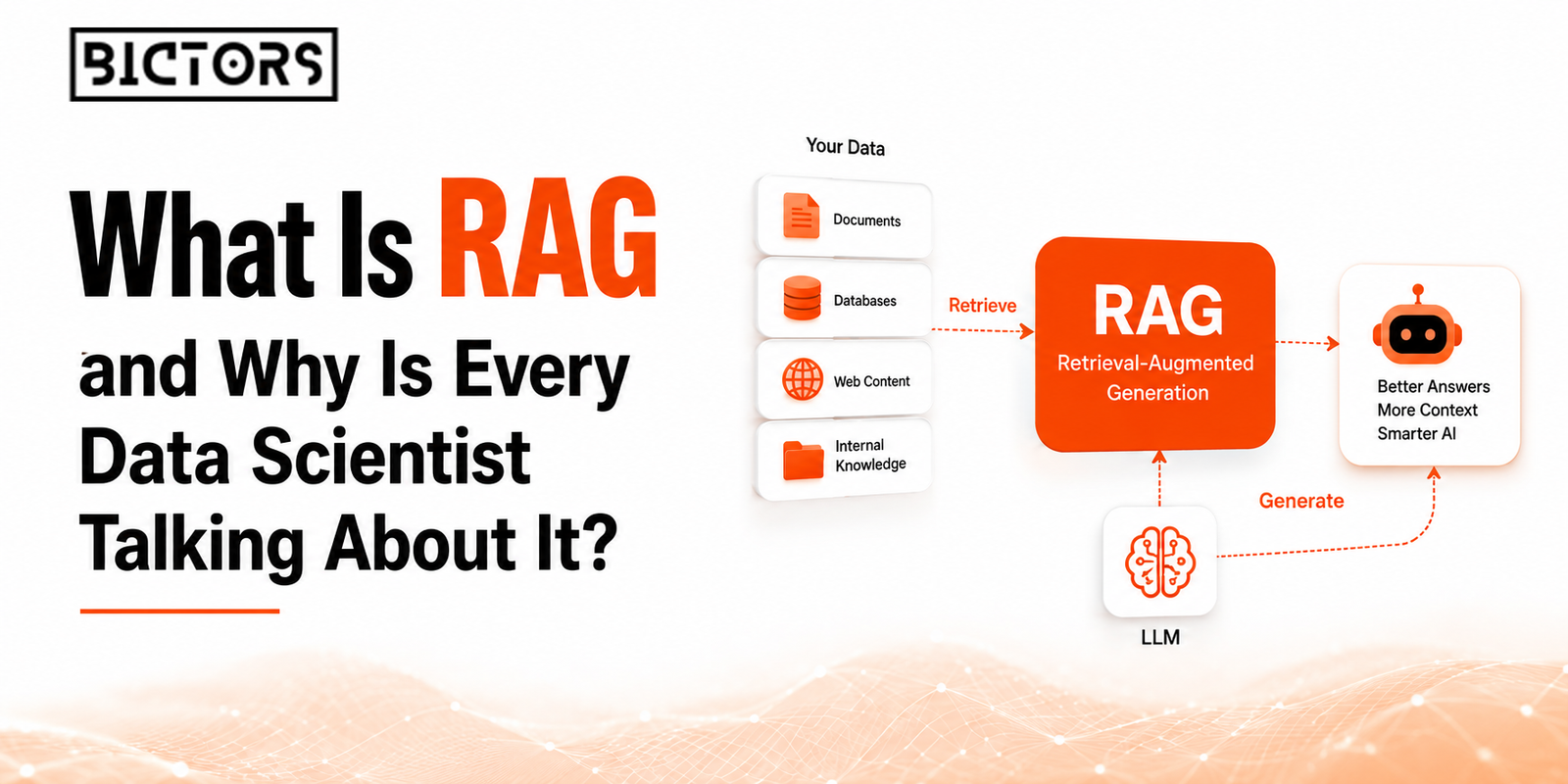
RAG, short for Retrieval-Augmented Generation, is an AI setup that gives a language model access to real, up-to-date facts before it answers you, rather than letting it guess from whatever it memorised during training. This is why every data scientist seems to be talking about it right now.
A model that checks its sources before speaking makes far fewer mistakes than one working purely off memory, and knowing how to build that kind of system has quietly become a core part of a good AI data science course in Bengaluru, Karnataka.
Table of Contents
- What Retrieval-Augmented Generation Is in Plain Language?
- Why RAG Exists and What Problem It Solves That LLMs Alone Cannot?
- How RAG Is Being Used in Real Indian Enterprise AI Applications?
- Why RAG Is Now a Core Skill in AI and Data Science Job Descriptions?
- How an AI Data Science Course Prepares You to Build RAG Systems?
What Retrieval-Augmented Generation Is in Plain Language?
RAG works by having the model look up relevant facts from an outside source before it writes an answer, instead of relying only on what it learned during training. Those retrieved facts get added to the prompt, so the response is built on something checked rather than something remembered. This way, the model answers from current, specific information instead of giving a guess as fact.
Why RAG Exists and What Problem It Solves That LLMs Alone Cannot?
A language model’s knowledge freezes the moment its training ends, so it has no way to know anything that happened after that cutoff. Ask it about something recent, and it either admits it does not know or answers with total confidence anyway, which is what people call hallucination. Retrieval-Augmented Generation solves this by connecting the model to a live source it can check before answering, instead of leaving it to make something up.
How RAG Is Being Used in Real Indian Enterprise AI Applications?
Indian companies across sectors are already running RAG quietly in the background of everyday work, not as a pilot project but as something employees use daily:
- Customer Support Desks: Chatbots that pull answers straight from a company’s own policy documents instead of generic training data.
- HR Helpdesks: Internal bots that check a company’s leave and reimbursement policies on the spot, so employees get an answer without digging through the onboarding manual themselves.
- Compliance and Legal Teams: Systems that scan long regulatory PDFs and spit out the exact clause someone’s looking for, not the whole document.
Why RAG Is Now a Core Skill in AI and Data Science Job Descriptions?
Hiring managers have stopped being satisfied with candidates who can only train a model from scratch. What most listings ask for now is someone who can connect a model to real business data, safely and quickly, without months of retraining, and RAG is exactly the skill that does that. That shift in what companies want is why the term keeps turning up in posting after posting.
Want to see where RAG leads next as companies move toward agentic AI?
Read our blog: How an AI Data Science Course Prepare You for the Agentic AI Revolution
How an AI Data Science Course Prepares You to Build RAG Systems?
An AI data science course does not just explain RAG on a slide and move on. It builds the actual skill through hands-on training:
- Foundations First: Understanding how large language models generate text, and where their limits sit.
- Vector Databases and Pipelines: Learning how documents get chunked, indexed, and connected to a live model using industry-standard tools.
- Real Projects: Building a working RAG system end-to-end, rather than only reading about one, so the concept turns into something you can actually deploy.
This is the kind of training that turns “I have heard of RAG” into “I have built one,” and it is exactly the set of data science skills most hiring managers are screening for.
Make RAG Your Next Skill with Bictors
RAG is not a passing trend sitting in a textbook. It is turning into the standard way AI systems stay accurate and trustworthy, and the data scientists who understand it are the ones getting hired first. Contact Bictors to build that skill set the practical way, with real projects and guidance.
Curious how this connects to other roles in AI? The next blog looks at why so many data engineers are moving into AI architecture roles.
Frequently Asked Questions
- Does RAG replace the need for a large language model entirely?
RAG works alongside a language model, adding a retrieval step rather than taking its place.
- Is RAG only useful for text-based data like documents?
Structured data, such as databases and spreadsheets, can also be connected through RAG.
- Does building a RAG system require a huge dataset to start with?
A small, well-organised set of documents is often enough to get a working RAG system running.