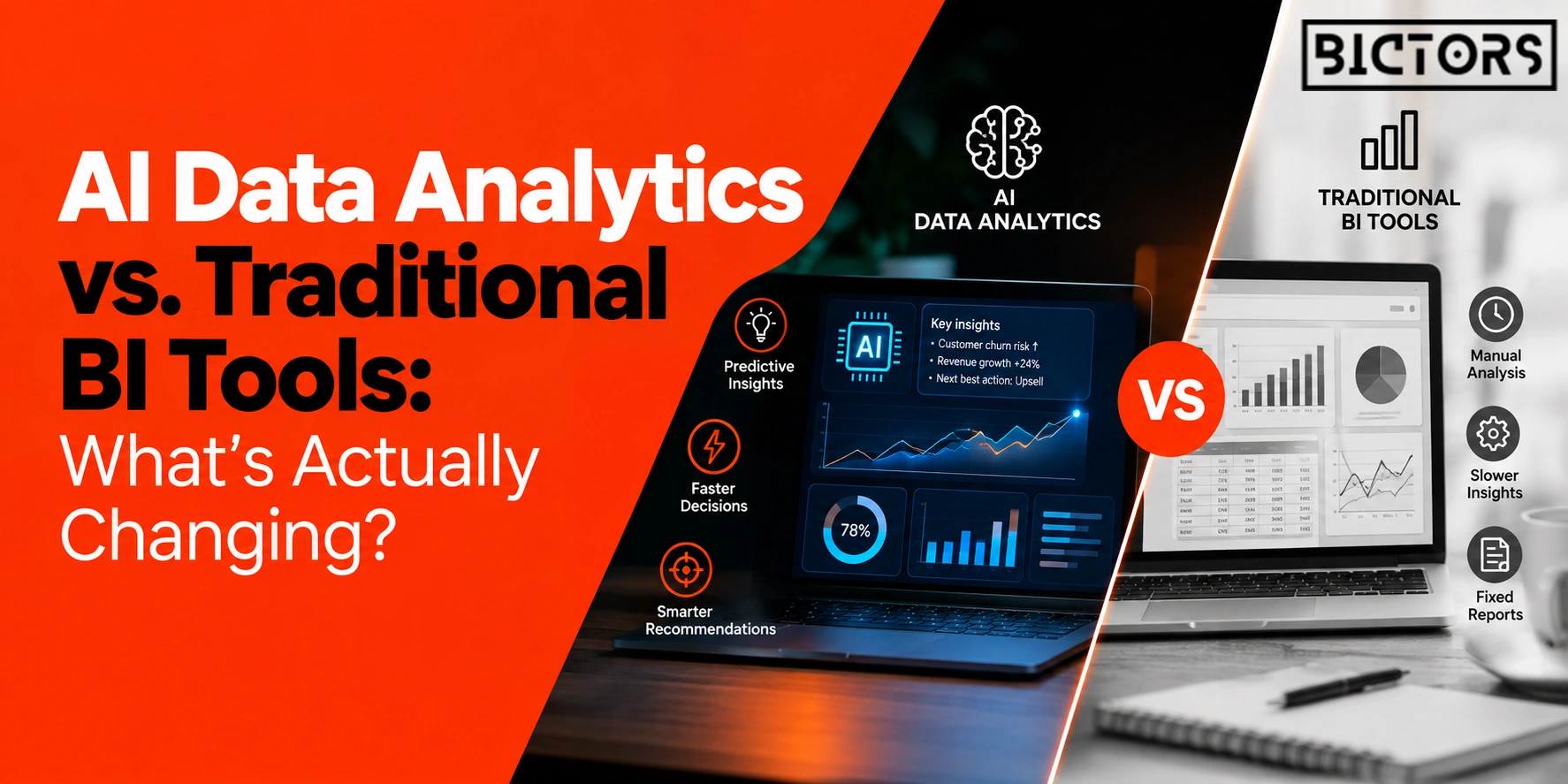
AI data analytics is moving away from reports built by hand after the fact, replacing them with tools that work on their own, respond conversationally, and look ahead instead of behind. That lag between something going wrong and someone noticing it has quietly been one of the highest costs in business analytics for years.
We at Bictors have seen interest in our AI data analytics course in Bengaluru grow quickly, as companies look for people who can work with these newer tools.
Table of Contents
- How Is AI Shifting Analytics From Reactive Dashboards to Proactive Alerts?
- Can Natural Language Queries Really Replace Manual Dashboard Building?
- How Much Faster Is AI-Driven Insight Compared to Traditional Batch Reporting Cycles?
- Where Do Traditional BI Tools Still Outperform AI Analytics Platforms?
- Will AI Replace BI Tools Entirely, or Will the Two Converge Into a Hybrid Model?
How Is AI Shifting Analytics From Reactive Dashboards to Proactive Alerts?
AI shifts analytics by replacing static charts that only show what already happened with automated alerts that flag problems or unusual changes the moment they start showing up. Analytics is moving from something you check to something that checks on you. At Bictors, this is one of the first things we cover in the course, since understanding this shift makes every other tool and technique easier to place.
Can Natural Language Queries Really Replace Manual Dashboard Building?
Natural language queries handle everyday, one-off questions well, replacing the need to write a query or wait on a data team for a quick answer. For tasks that repeat often and need the same view every single day, a properly built dashboard still does the job better. At Bictors, this is one of the practical skills covered in our AI-powered data analytics training in Bengaluru, since knowing when to ask a question versus when to rely on a fixed dashboard is a skill in itself.
Check Out: Data Analyst vs. AI Data Analyst: Comparing Roles and Salaries
How Much Faster Is AI-Driven Insight Compared to Traditional Batch Reporting Cycles?
AI-driven platforms can turn data into insight in seconds or minutes, while traditional batch reporting often takes hours, sometimes even days, to produce the same answer. A report that used to run overnight and get reviewed the next morning can now flag the same issue the moment it shows up in the data. At Bictors, we make sure students work directly with these real-time tools during the course, rather than only reading about how fast they are. A few ways this speed shows up in practice:
- Anomaly Detection: A weekly review used to be the moment unusual patterns got noticed. Now it happens the instant they appear.
- Root Cause Analysis: Instead of one person testing a theory at a time, multiple factors get checked automatically and at once.
- Forecasting: You used to wait for the next report to see an updated prediction. Now it just changes as new data rolls in.
Where Do Traditional BI Tools Still Outperform AI Analytics Platforms?
Traditional BI tools still win when reporting needs to be precise, auditable, and consistent every time. A finance team closing the books relies on exact numbers, something a probability-based estimate can’t offer. At Bictors, both these tools are taught side by side, so students know how to use each one for the job it actually suits.
Data visualisation and business intelligence platforms also remain stronger for building polished, boardroom-ready reports.
Will AI Replace BI Tools Entirely, or Will the Two Converge Into a Hybrid Model?
Full replacement seems unlikely, and a hybrid model looks like the more realistic direction. BI tools are good at showing what already happened with total accuracy, while AI is better at explaining why it happened and predicting what comes next. Our course at Bictors covers both sides, from tools like Power BI and SQL to newer AI-driven analytics skills, since most workplaces expect familiarity with each rather than just one.
Most teams end up needing both, which is why the difference between AI analytics and traditional BI tools is becoming less about picking a side and more about knowing when to use which one.
Master AI Data Analytics with Bictors’ Program in Bengaluru
The real question for most businesses isn’t AI versus BI anymore. It’s how to blend data visualisation and business intelligence with newer predictive analytics tools without one getting in the other’s way.
Want to build these skills hands-on rather than just read about them? Contact Bictors and join the AI data analytics program in Bengaluru. The tools will keep changing, but knowing how to use both well is what actually matters in the long run.
Next up, we will take a look at what goes into an actual generative AI portfolio- the kind that gets you hired. Stay tuned.
Frequently Asked Questions
Do you need a coding background to start learning AI data analytics?
You’ll pick up the coding basics as you go, so no prior experience is required to begin.
How soon can you expect to work on real projects during the course?
You’ll start working with real datasets early on, rather than waiting until the final weeks.
Will this course help you transition from a non-analytics background?
Yes, plenty of learners join from unrelated fields and build analytics skills from the ground up here.