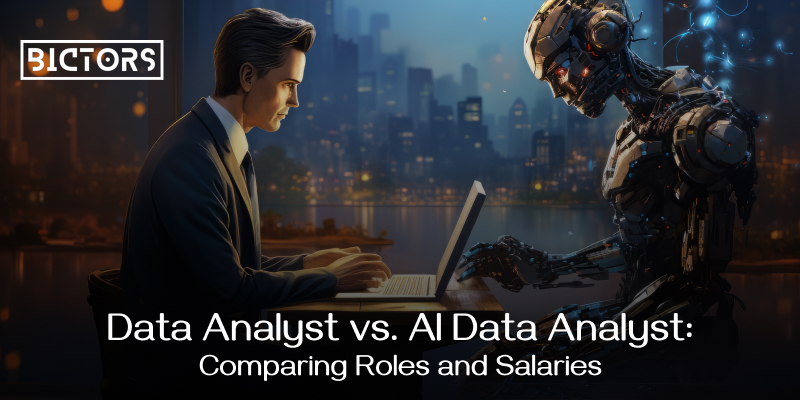
You opened a job listing that looked promising. The title said “Data Analyst.” Decent pay, familiar skills, something you could realistically work toward. Then you scrolled down to another one. “AI Data Analyst.” Same job description on the surface, but the salary range made you do a double-take. It was noticeably higher. Both roles work with data and the same industry. So why the gap?
It comes down to one shift in how these roles actually work, and it is worth understanding before you decide where to take your career next, especially if you are looking into an AI data analytics course in Bhubaneswar.
Table of Contents
- So What Does an AI Data Analyst Actually Do?
- What Skills Do You Need for AI Data Analytics?
- Which Pays More: Data Analyst or AI Data Analyst?
- Is an AI Data Analytics Course Worth It in 2026?
- Can I Become an AI Data Analyst with a Course in Odisha?
So What Does an AI Data Analyst Actually Do?
A regular data analyst works with historical data. They clean it, query it, build dashboards, and produce reports that help a business understand what happened last quarter, last month, or last week. The work is structured, and the questions usually come from someone else.
An AI data analyst does all of that, but differently. They work with platforms that automate much of the repetitive work, freeing them to focus on bigger questions about prediction, trends, and future outcomes. They also carry a responsibility that does not exist in traditional analyst roles: making sure the AI is not quietly getting things wrong. A tool can generate a chart or summary in seconds, but without someone cross-checking the underlying logic, that output can mislead an entire team.
Here’s a quick look at what the day-to-day actually covers:
- Data preparation and cleaning: Organising messy data so it’s usable, often with help from automated tools.
- Pattern spotting and analysis: Finding trends across large datasets, sometimes without writing a single line of code.
- Report building and communication: Taking complex findings and presenting them in a way that makes sense to someone who has never opened a dataset.
- Checking AI results: Ensuring the machine’s suggestions actually make sense in real life.
You May Like: With Data Science Learn How to Transition from Legacy Systems to Data-Driven Organizations
What Skills Do You Need for AI Data Analytics?
The skill requirements for this role can look intimidating at first glance. However, that feeling usually goes away once you see what each skill actually involves on a day-to-day basis.
Technical Skills:
- Python: Know enough to handle your data, automate the time-consuming parts, and work with AI platforms without needing a developer sitting next to you.
- SQL: The first thing most hiring managers look for; if you cannot query a database, the rest of the skills do not matter much.
- Machine learning basics: Not about building models yourself, but understanding what a model is doing well enough to know when the output does not add up.
- AutoML tools: They take care of a lot of the modelling work in the background, so you are not spending days on setup every time you need an answer.
- Data visualisation: Turning a table of numbers into a chart that a non-technical manager can look at and immediately understand; tools like Power BI handle most of this.
- Statistical understanding: Knowing enough about probability and regression to sense-check whether a result is realistic or something has gone wrong upstream.
- Big data tools: At some point, Excel hits a wall, and standard SQL starts to slow down; that is when tools like Apache Spark enter the conversation.
Soft Skills:
- AI literacy: Knowing how to work with generative AI tools like LLMs and LangChain as a co-pilot, using them to speed up routine tasks like report generation and data querying while staying critical of the outputs they produce.
- Business acumen: Know the real business goals and tie data findings to them. Not just reporting numbers, but reporting what they mean for decisions.
- Communication: Presenting complex findings to people who have never opened a dataset in their lives.
- Critical thinking: Knowing when to trust the AI and when to push back on it.
The technical skills are learnable. What actually separates good AI data analysts is their ability to connect data to decisions and explain the “so what” clearly.
Which Pays More: Data Analyst or AI Data Analyst?
Most people considering a career switch want to know one thing before anything else: Does it actually pay better? In this case, it does, and the difference is hard to ignore.
A traditional data analyst earns well. The pay is stable, it grows with experience, and it is a respectable career in its own right. An AI data analyst, working in the same industry and with the same data, earns more. Starting salaries are higher, mid-career pay increases more quickly, and senior professionals in this role make significantly more. Skills in machine learning, generative AI or cloud platforms push those numbers even higher.
Why the difference? A traditional analyst looks at what has already happened and reports on it. An AI data analyst looks ahead, builds predictions about it, and sets up automated systems to respond to it. Companies value that more, and they are paying accordingly.
Is an AI Data Analytics Course Worth It in 2026?
The demand for people who can work with both data and AI is real and outpacing the supply of qualified professionals. A course is worth it if it puts you in front of actual tools and real problems rather than slides and theory. An AI data analytics course in Odisha is increasingly relevant to industries in the region itself, not just a ticket to remote work elsewhere.
Can I Become an AI Data Analyst with a Course in Odisha?
Yes. There is still an assumption that serious career moves only happen in metro cities. That is not how this field works anymore. The tools are cloud-based, the work is remote-friendly, and quality learning is accessible from anywhere. What matters is choosing a course that focuses on real skills rather than certificates. Bictors does that, and it does it for people right here in Odisha.
Wrapping It Up
The gap between the two roles is not as big as job descriptions make it seem. The foundation overlaps, the tools are learnable, and the transition is more gradual than most people expect. What does change is where your career goes. Better pay, faster growth, and a role that companies are actively hiring for right now. If you are thinking about making that move, an AI data analytics course at Bictors in Bhubaneswar, Odisha, is a good place to start. Contact us for more information.
Frequently Asked Questions
- What does an AI data analyst actually do day to day?
They handle data collection, quality checks, analysis, pattern spotting, reporting, and verifying that AI outputs actually make sense for the business.
- What tools does an AI data analyst typically work with?
They use a mix of semantic layers, data quality tools, natural language query platforms, ML lineage trackers, and BI platforms to keep data clean and useful.
- What skills does someone need to work as an AI data analyst?
Strong SQL and Python, a solid grasp of data governance, and the ability to work alongside AI systems to catch errors and stay compliant.