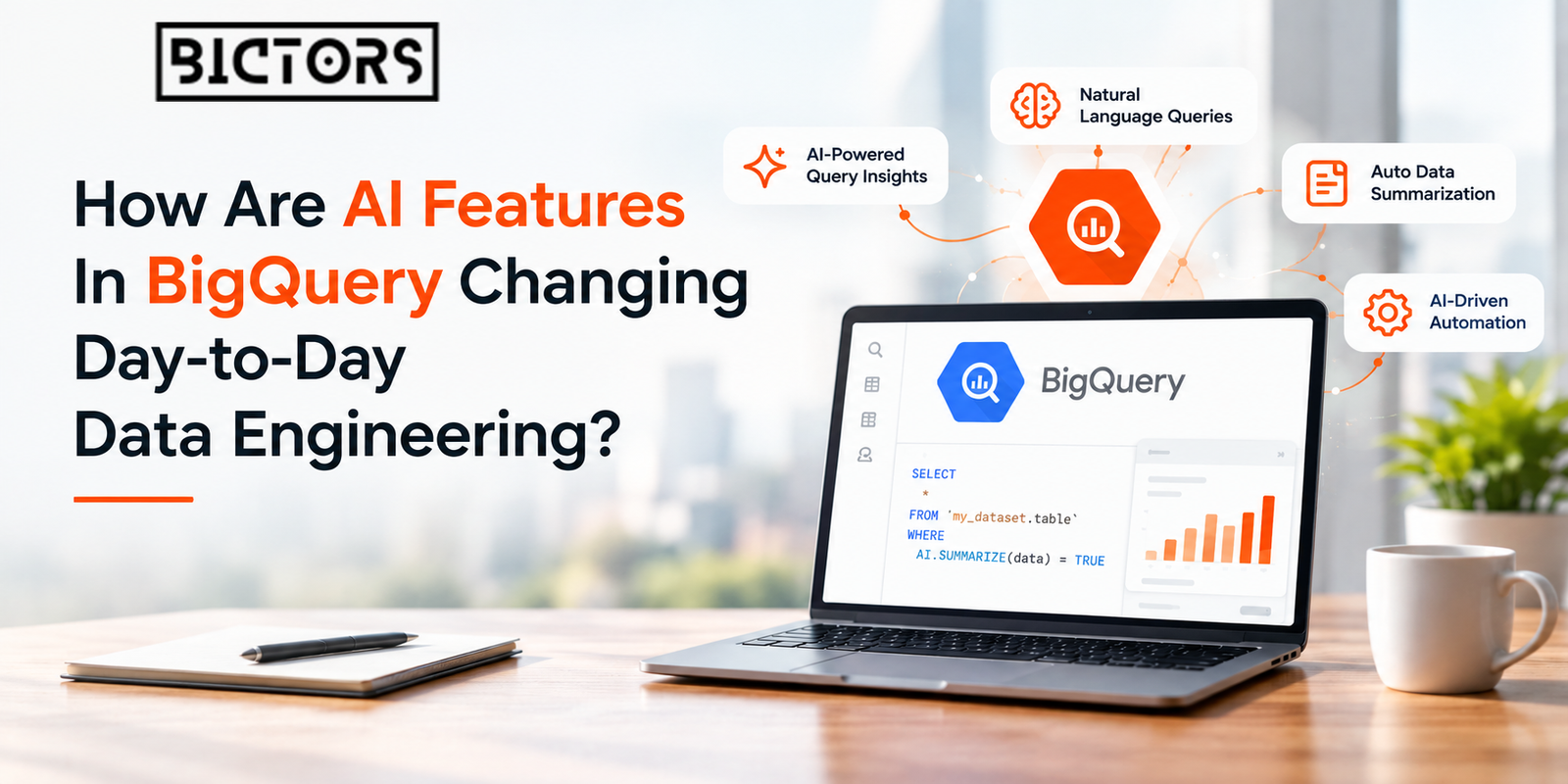
BigQuery’s built-in AI now helps with the repetitive parts of data work, such as writing, explaining, and fixing code, which leaves engineers more time for decisions. A report due by morning does not have to mean a long hunt through one stubborn query. If you are exploring a GCP data engineering course in Bengaluru, we at Bictors help you learn to work with AI-assisted tools alongside your core skills.
Table of Contents
- What AI Assistance Now Exists for Writing and Explaining SQL and Pipelines on GCP?
- How Can Engineers Use It for Debugging and Optimisation?
- Which Tasks Still Need Engineering Judgement?
- How Does Built-In AI Change What Companies Expect From Junior Engineers?
- What Should Learners Practice so They Can Supervise AI-Generated Code?
What AI Assistance Now Exists for Writing and Explaining SQL and Pipelines on GCP?
Gemini in BigQuery is an AI assistant inside BigQuery Studio that turns a plain-language request into SQL or Python code and explains existing queries. For pipelines, the Data Engineering Agent can build and modify them from natural language prompts. Once enabled, it works in the same workspace, though some features are still in preview, so availability can vary. At Bictors, we teach AI-assisted data engineering on real projects, including when to lean on these BigQuery AI features and when to step in.
How Can Engineers Use It for Debugging and Optimisation?
Engineers can use AI-assisted SQL optimisation in BigQuery to review slow queries and trace why a pipeline failed, then judge each suggested fix before applying it. The assistant gives a starting point, and the engineer confirms it is correct and cost-efficient.
Our instructors at Bictors teach pipeline optimization hands-on, which is how you learn to tell a good suggestion from a risky one. Here is where AI helps most in a normal week:
- Error Tracing: It helps you narrow down the failing step faster.
- Query Tuning: It can point out cleaner joins and ways to scan fewer rows, which you then check.
- Plain Explanations: It walks you through a teammate’s old code step by step.
Read our blog: What Should GCP Data Engineers Prepare For Next?
Which Tasks Still Need Engineering Judgement?
Even with AI helping with much of the coding in BigQuery, people make the final calls on how data is organised, what a business number really means, and who can see sensitive details. AI offers options, but it cannot know your company’s goals. These are the data engineer skills for GCP that no tool replaces. At Bictors, our capstone project lets you make these calls yourself while mentors review your choices.
How Does Built-In AI Change What Companies Expect From Junior Engineers?
With AI built into BigQuery, employers increasingly expect junior data engineers to deliver working pipelines faster and to check AI-written code carefully instead of typing every line by hand. The data engineer skills for GCP that count most now are giving clear instructions, reading code with a critical eye, and understanding how data flows from source to report. Our instructors at Bictors help you build these skills through hands-on projects and mock interviews.
What Should Learners Practice so They Can Supervise AI-Generated Code?
Learners should practise reading AI-generated code line by line, testing it on a small sample, and explaining why each step is there. A wrong join or a missing filter is easy to spot this way, long before it reaches production.
In our GCP data engineering training in Bengaluru, we at Bictors practise this on real projects. Mentors review your work as you go, and the course covers BigQuery, Dataflow, Pub/Sub, Airflow, and dbt. Here is what to practise:
- Code Reading: Take one query and write a short note beside every clause. If you can’t say what a line is for, that’s the line to question.
- Small Tests: AI-written code should meet a sample table before it meets the real one. A dry run also shows how many bytes it would scan, so the cost is no surprise.
- Core SQL: Joins and filters. Once these feel automatic, a doubled row count or a missing WHERE condition stands out quickly.
Turn BigQuery AI Skills Into a Career With Bictors
Day-to-day data engineering is changing, and BigQuery AI features are a big part of that shift. Drafting and explaining code takes less time now, which leaves more room for the work that needs a human, such as designing pipelines and checking numbers. The engineers who do well will be the ones who can supervise AI instead of simply accepting what it gives them.
Contact Bictors to join our GCP data engineering program in Bengaluru and practise these skills on real projects, with mentor feedback at every step. A strong foundation today keeps your career steady as the tools keep improving.
Our next read looks at how you can keep growing as a GCP data engineer once the fundamentals are in place.
Frequently Asked Questions
Will AI features in BigQuery replace data engineers?
AI features in BigQuery help with routine coding tasks, while you still design the pipelines, check the results, and make the final decisions.
Should you review AI-generated SQL before using it on real data?
You should test every AI-generated query on a small sample first, because a query that runs without errors can still return wrong numbers.
Can beginners learn to use BigQuery AI features effectively?
You can start early, since describing a task in plain language is easy, and we at Bictors teach you to check each result so your SQL fundamentals grow alongside.