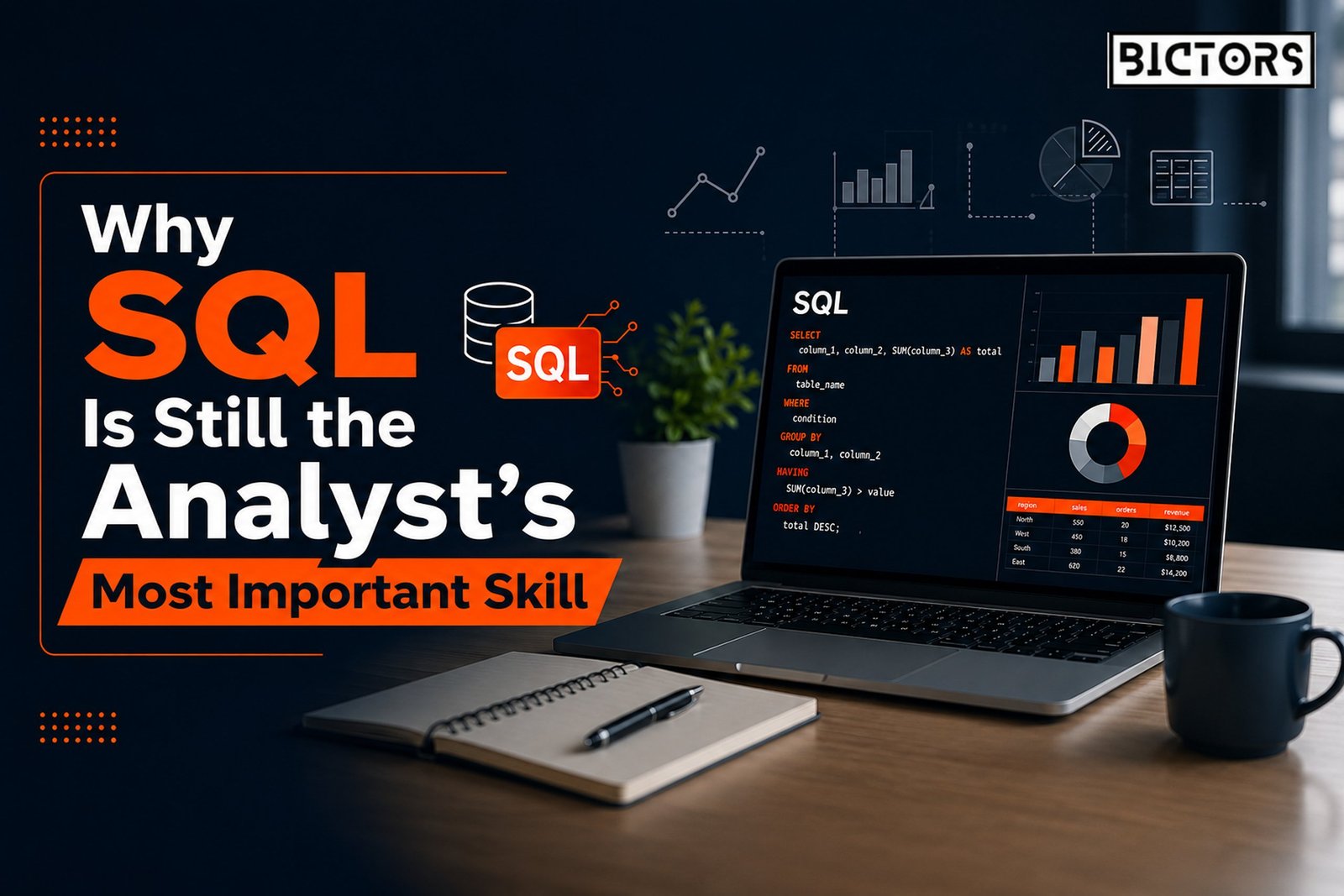
SQL stays essential because most business data still lives in relational databases, from retail chains to global banks, and SQL is the only language those systems speak. AI tools and Python make analysis faster, but they still depend on SQL underneath to pull and combine actual data. Anyone considering joining an AI data analytics course in Bengaluru, Karnataka should know this going in, so they choose one that actually teaches SQL well instead of treating it as optional.
Table of Contents
- Why Hasn’t AI Made SQL Obsolete Despite Natural-Language Query Tools?
- What Advanced SQL Concepts Do Hiring Managers Actually Test For?
- How Does Strong SQL Knowledge Help You Evaluate AI-Generated Queries?
- What’s the Difference Between Knowing SQL Basics and Being SQL-Fluent on the Job?
- How Does SQL Fit Alongside Python and BI Tools in an Analyst’s Toolkit?
Why Hasn’t AI Made SQL Obsolete Despite Natural-Language Query Tools?
AI hasn’t replaced SQL because guessing at a question isn’t the same as answering it correctly. Ask for “last quarter’s top customers,” and “top” could mean revenue, order count, or profit margin, with no way for an AI tool to know which one matters to your business.
At Bictors, we make sure students understand this distinction early, since SQL for data analytics forces the kind of precision an AI tool can’t guess its way into; every entry has to be accurate, consistent, and traceable. That level of accountability is something a chatbot answer can’t offer.
What Advanced SQL Concepts Do Hiring Managers Actually Test For?
Anyone can write a simple SELECT statement, but the real skill comes in using window functions, nested subqueries, and multi-table joins. At Bictors, we train students on exactly these areas, since breaking down that complexity is what demonstrates a candidate’s ability to operate in a real job. Here’s what they’re really after:
- Multi-Table Joins: Combining data from several tables without losing track of what connects to what is a basic filter most candidates fail.
- Window Functions: Ranking, running totals, and calculations beyond a simple row-by-row query separate candidates who know syntax from those who understand data.
- Query Optimisation: A working query isn’t the bar. Recruiters want queries that run fast on large datasets too.
- Index Awareness: If you know the performance implications of indexes on large tables, you are thinking about the database, not just syntactic correctness.
Check This Out: A Day in the Life of an AI Data Analyst: What’s It Like
How Does Strong SQL Knowledge Help You Evaluate AI-Generated Queries?
Strong SQL knowledge lets you catch what AI tools miss; a query can look completely correct on the surface while quietly missing a join condition or misreading business logic. At Bictors, our instructors help students build the ability to catch exactly this kind of mistake, since a solid grasp of the fundamentals lets you spot it in seconds. That skill is what turns a data analyst into a fact-checker for AI output.
What’s the Difference Between Knowing SQL Basics and Being SQL-Fluent on the Job?
Knowing SQL basics means you can pull data when someone else has already set everything up for you. Being SQL-fluent means you can walk into a confusing, poorly organised database on your own and still get what you need without getting stuck. At Bictors, our data analyst skills training is built around exactly this, using real, disorganised datasets instead of neat textbook examples, so students are prepared for that kind of challenge.
How Does SQL Fit Alongside Python and BI Tools in an Analyst’s Toolkit?
SQL sits underneath both; Python and BI tools are really just layers built on top of it. Dashboards run on it behind the scenes, and before any analysis even starts, Python scripts are usually pulling raw data straight from SQL. It’s right here that the SQL skills you actually need for a data analyst job matter most- the part dashboards and scripts quietly depend on.
At Bictors, our course makes sure students really get this, so they know exactly what’s going on behind every dashboard and script.
- Powering BI Dashboards: Charts in Power BI look instant, but SQL is doing the actual work behind each one.
- Feeding Python Scripts: Python scripts generally don’t start with analysis; they start with pulling in raw data via SQL.
- Supporting Data Transformation Tools: Even as newer tools are built on top of SQL, modern data warehouses still rely on SQL to clean and reshape data at scale.
- Working Across Platforms: Different database platforms all speak SQL, while the tools built on top of them don’t stay consistent from one platform to the next.
Build SQL Skills That Employers Actually Look For
No matter how advanced AI tools get, SQL remains a core skill employers expect, and it’s the skill that makes every other tool in the job actually make sense. If you’re looking for the best AI and data analytics course for beginners, contact Bictors to join a program built around SQL as a central skill. By mastering SQL, every other tool in the job starts making sense.
Next up, we will get into how cloud platforms are redefining what data engineers need to know. Stay tuned!
Frequently Asked Questions
- Does the AI data analytics course work for someone switching careers with no data background?
The course starts with SQL fundamentals before moving into joins and real datasets, so anyone coming from a non-technical field can follow along.
- How much hands-on practice is included in the AI data analytics course?
Most sessions involve writing actual queries on messy, real-world datasets instead of watching someone else demonstrate it on a slide.
- Can what’s learned in the course be applied immediately at work?
Learners typically start writing basic reports or pulling their own data within the first couple of weeks, well before the course wraps up.