
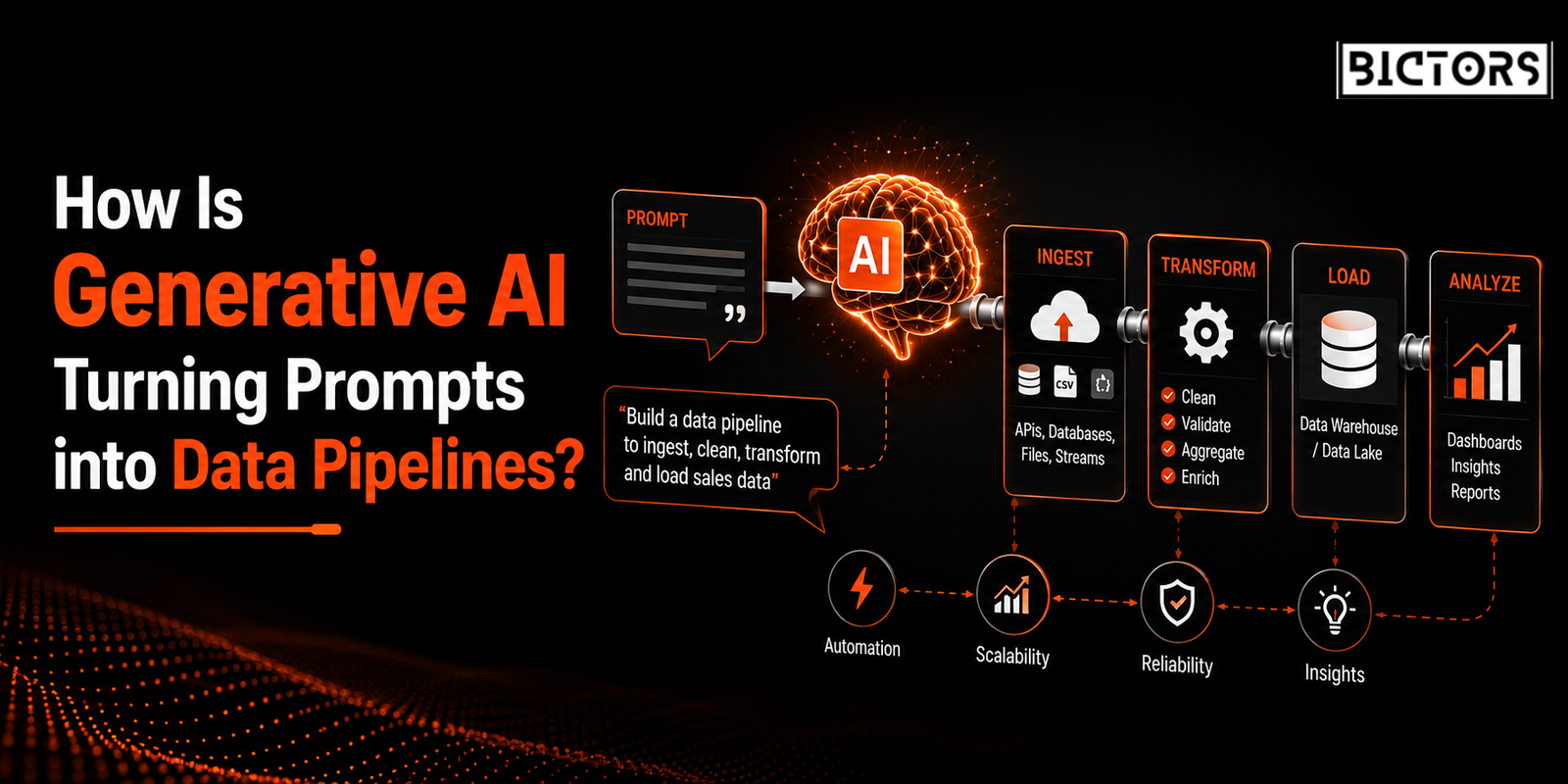
Generative AI turns a plain-text prompt into a working data pipeline by reading your intent, writing the underlying code, and wiring up the workflow steps automatically. What used to take days of writing scripts by hand now shows up as a working draft before your coffee gets cold.
That speed is exactly why more working professionals are searching for a generative AI data analytics course in Bengaluru, Karnataka, right now, curious about how a plain sentence can somehow turn into functioning code.
Table of Contents
- What Does a Prompt-to-Pipeline Workflow Actually Look Like End-to-End?
- Can GenAI Reliably Write Production-Grade ETL Code, or Just Drafts?
- How Do You Validate AI-Generated Pipeline Logic Before Deployment?
- What Skills Do Analysts Need to Direct GenAI Pipeline Generation Effectively?
- Where Does This Save the Most Time: Pipeline Design, Testing, or Maintenance?
What Does a Prompt-to-Pipeline Workflow Actually Look Like End-to-End?
A prompt-to-pipeline workflow starts with a plain-language request and ends with a working pipeline pulling, cleaning, and loading your data on its own. You describe what you want in everyday words, and the rest happens without you touching a line of code. This is prompt-to-pipeline automation in its simplest form, less about typing code, more about describing outcomes.
Here’s what happens behind the scenes:
- Intent Reading: The system first reads your prompt, figures out what data needs to move and where it needs to go.
- Schema Mapping: Your data sources get scanned so it can spot the structure and line up matching fields on its own.
- Workflow Building: SQL or Python gets written from there, and everything connects into a working pipeline without you touching a single step.
Can GenAI Reliably Write Production-Grade ETL Code, or Just Drafts?
GenAI writes solid first drafts of ETL code, but production-grade reliability still needs a human to check the logic before it goes live. GenAI for ETL pipeline generation works well for standard formats, common data sources, and predictable transformations. Where it gets shaky is anything involving business-specific rules the model was never told about, code that runs fine but still gets the logic wrong.
How Do You Validate AI-Generated Pipeline Logic Before Deployment?
Validating AI-generated pipeline logic means running it against real data and checking the output against what you actually expected, not just whether it ran without errors. This is the part teams often rush past because the code looks clean on the surface. Knowing how to validate
AI-generated data pipelines before deployment have become one of the more valuable skills an analyst can carry into this shift, catching small mistakes before they turn into a bigger mess downstream.
You May Find Interesting: How Generative AI Is Changing the Way Data Analytics Works
What Skills Do Analysts Need to Direct GenAI Pipeline Generation Effectively?
Directing GenAI pipeline generation effectively comes down to knowing what to ask for and how to check what comes back. The skills worth building for this shift are:
- Prompt Clarity: Your request needs to be specific enough that the model does not have to guess what you meant.
- Schema Awareness: You should know your own data well enough to catch when something has been mapped wrong.
- Logic Review: Going over generated code to see where the business logic is just off.
- Testing Habits: Small checks before trusting any pipeline with real data, every single time.
This is the kind of thinking a generative AI data analytics course for working professionals in Bengaluru actually trains you for: less memorising syntax, more learning to direct the tool well.
Where Does This Save the Most Time: Pipeline Design, Testing, or Maintenance?
Pipeline design sees the biggest time savings by far. A rough structure that used to take days can now show up in minutes. Testing picks up some time savings too; the system can draft basic checks on its own without much prompting.
Maintenance is where things slow back down. Broken pipelines still need a person to figure out why something failed, not just a patch that makes the error message disappear.
Join the Generative AI Data Analytics Course At Bictors
Data knowledge still matters just as much as before. Prompts have simply changed where you apply them. This is the real focus of a generative AI data analytics course in Karnataka, teaching you when to hand things over to the tool and when to step in yourself.
Reach out to Bictors and sign up for a course that shows you how it actually works, hands-on. So the next time someone asks how a pipeline came together, you will have a real answer
Coming up, we will get into why SQL still holds its ground as one of the most essential skills an analyst can have, even with all this automation around it.
Frequently Asked Questions
- Do you need a background in data engineering to join this course?
The course starts from the fundamentals and takes you up from there, so no prior data engineering background is required.
- Does the course include hands-on project work?
Learners work on real project-style assignments throughout the program.
- Is mentorship support available during the course?
Expert mentors are available throughout the program to guide you through concepts and projects.